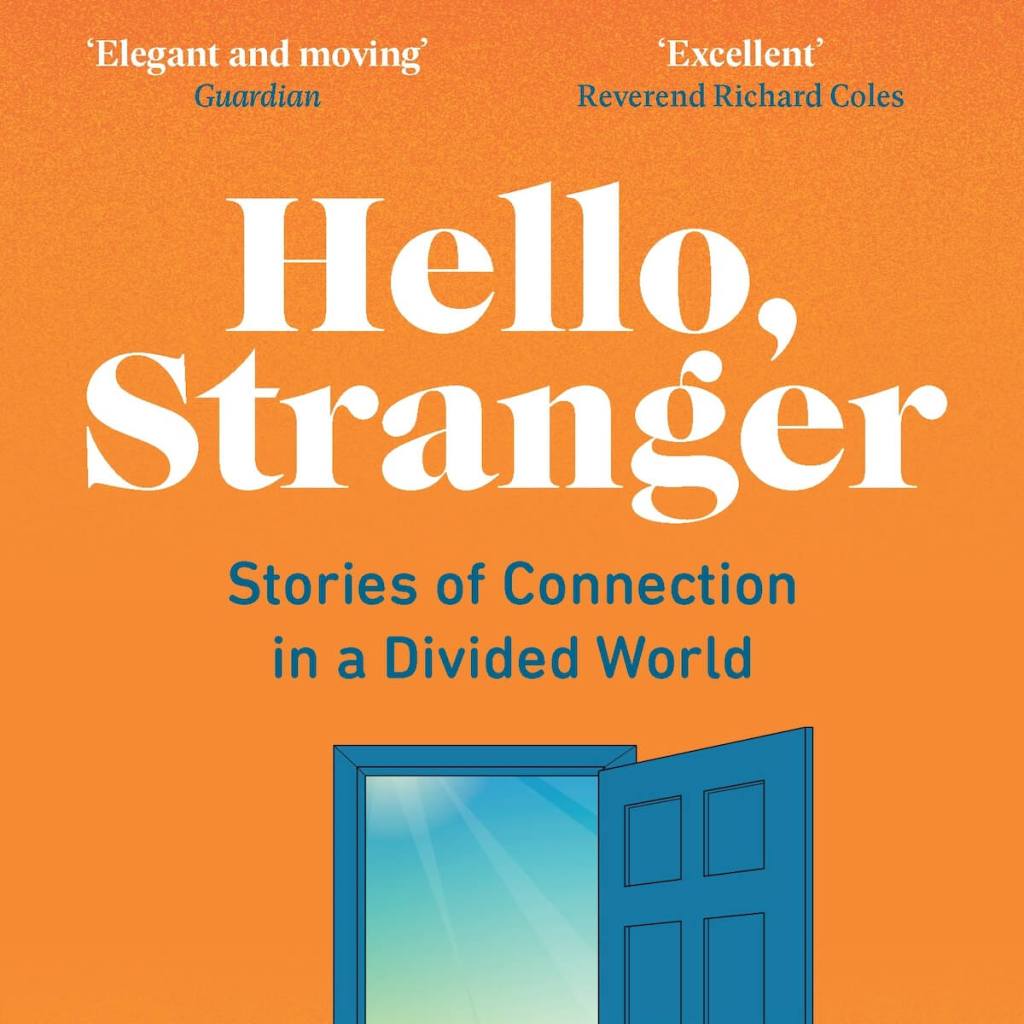
In preparation for a long train journey from London to Edinburgh, I stopped by the library in search of a travel companion in book form. Between the shelves, a title caught my eye: Hello, Stranger. Smiling, I thought, “Hello to you too,” and picked it up. The full title read: Hello, Stranger: Stories of Connection in a Divided World, by writer, philosopher and anthropologist Will Buckingham.
Carefully researched and tenderly told, Buckingham’s book explores the complex nature of our encounters with strangers. These interactions can stir anxiety, but they also carry the potential for renewal and hope. His personal anecdotes are proof that even fleeting connections can broaden our perspectives and open us to new experiences.
Strangers: Fear and Fascination
The first part of the book focuses on the delicate interpersonal dynamics in the contact with strangers. Buckingham notes that our responses to strangers are always double-edged: a mix of anxiety and possibility, excitement and fear. Strangers are unknowable — what they think, what they carry, what they might do is beyond our grasp. This fuels both suspicion and curiosity.
The Greeks had a word for this duality: philoxenia, the love of strangers. It stands in tension with xenophobia, the fear of them. Together, they form the ambivalence at the heart of every new encounter — hospitality and hostility, curiosity and caution. To bridge the gap, humans have long relied on rituals:
“Ritual, play, joking, offering of food and drink: is the craft of building trust.”
Yet trust can be fragile, bound by unwritten codes of honour that both connect and divide us.
Strangers in a Wider World
The second part gradually expands the picture, by seeing the stranger in a larger context. From personal encounters, Buckingham expands the lens to the global stage. Borders, thresholds and divisions often deepen our mistrust of strangers. At times, newcomers are welcomed; at others, they are excluded. Yet, as Michael Fisher writes in Migration: A World History:
“Migration has always been central to human identity’.
Movement is not just necessary — it is also rewarding. Buckingham reflects that:
“We like the thrill of it. If home makes us feel good, so too does being on the road. Research suggests travel leads to greater creativity, to cognitive flexibility. It wakes us up, makes us feel more alive.”
During my visit to Scotland, I stayed with an old friend whose open-heartedness creates bonds with neighbours and dog-walkers in the community. She weaves kinship out of proximity and care. As Buckingham reminds us:
Kinship is never just about biology, or about affiliation. It is about closeness, about what is shared, about the way we connect and reconnect, and between us forge enduring bonds.
Loneliness and Trust
Not everyone can sustain such openness. When doors remain closed, isolation takes root. Prolonged isolation can grow into loneliness — a state that makes us more risk-averse, less willing to trust, and more likely to withdraw. This cycle of mistrust and loneliness can spiral into something deeply harmful.
Research shows that when loneliness degrades our ability to trust, the consequent mistrust is directly not just outwards, towards strangers, but also those who are closest to us.
Healing Through Strangeness
Yet in spite of its diversity and fragmentation, the world can be an inexhaustibly resourceful place. After the death of his wife, Buckingham found solace in strangeness itself:
Immersed in strangeness, surrounded by strangers, suddenly strange to myself, I was allowing myself to become other than I had been. Exhausted, utterly incapable of rebuilding my life by my own resources, I was allowing myself to be refashioned by this vast, inexhaustible world.
In a time when I too live between worlds, navigating my own sense of strangeness, this book felt like a gift. It reminded me that loneliness can be softened through openness:
“This is how loneliness is overcome. Through opening up channels for generosity. Through the mutual giving of gifts. Through the way pleasures are multiplied when they are shared.”
Hello, Stranger reframes strangeness in more human terms, softening its edges and making it feel less foreign. In doing so, it helps us recognise the stranger not only out there in the world but also within ourselves — and, perhaps, to find belonging among the billions of strangers who share this planet we call home.

 Mindful Loneliness